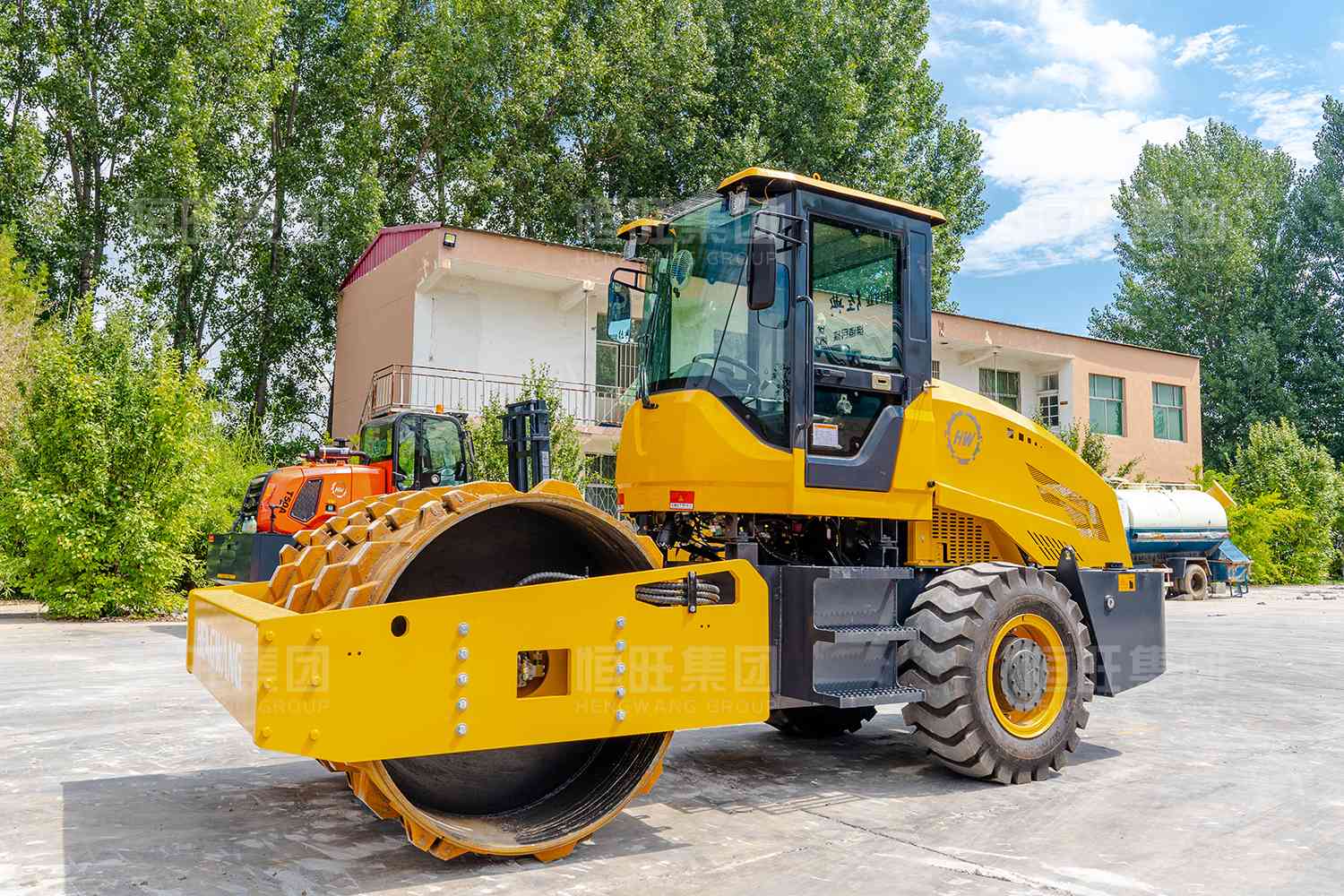
Clay Soil Construction Key Points
When operating on clay soil, its fine particles and strong cohesion require a high-frequency compaction strategy. It is recommended to use heavy-duty vibratory rollers above 18 tons, with the loose paving thickness per layer controlled within 20cm. Construction data shows that clay soil needs 8-10 passes of compaction to achieve 93% compaction degree, 3-4 more passes than sandy soil. Maintain a low speed of 3-4 km/h to ensure the roller fully contacts the soil layer.
Optimized Solutions for Sandy Soil
Aiming at the loose characteristics of sandy soil, a 15-ton vibratory roller is preferable. The particle fluidity facilitates rapid restructuring, usually requiring 5-7 compaction passes to meet standards. Adopt a "static compaction + strong vibration" combination: first pass for static leveling, followed by alternating strong vibration (3-4 passes) and rubber wheel final compaction (2 passes). Tests show this scheme increases density by 25% and effectively avoids sand liquefaction.
Silty Soil Treatment Technology
Silty soil combines characteristics of both clay and sand, requiring balance between moisture content and compaction parameters. The optimal moisture content is 12%-14%, using an 18-ton vibratory roller for layered compaction. Recommend the "sandwich" compaction method: 3 passes of strong vibration for the lower layer, 2 passes of rubber wheel kneading for the middle layer, and static compaction for the surface. This process can raise the CBR value to over 8, meeting subgrade bearing requirements.
Construction Notes
Special Condition Handling
By optimizing roller selection and compaction parameters, the compaction quality of different soil types can be significantly improved. It is recommended to construct a 30m test section before formal construction to adjust process parameters based on measured data, ensuring the subgrade compaction qualification rate exceeds 95%.